Delimitation Debate - The myth of a Monolithic South
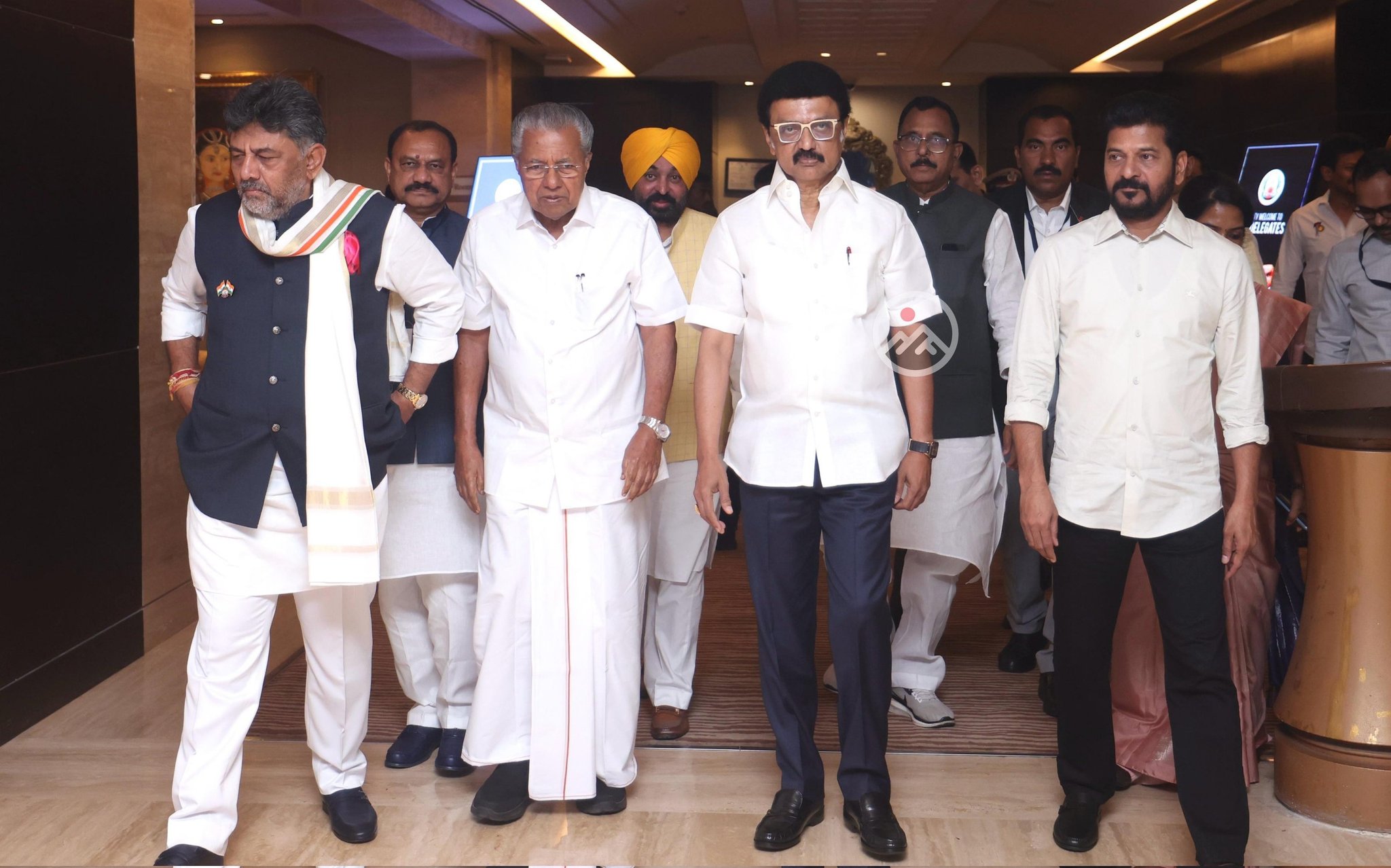
Opposition leaders from the Congress, DMK, BRS, and allied parties, including Telangana Chief Minister A. Revanth Reddy and Tamil Nadu Chief Minister M.K. Stalin are framing the upcoming delimitation exercise as an existential threat to "South India." They warn of a loss of political power and cast it as a North-versus-South conspiracy. Yet, this narrative crumbles under scrutiny. There is no monolithic "South India" standing united against the rest of the country. Regional identities, rivalries, and selective outrage reveal a far more fragmented and opportunistic picture.
Opposition leaders from the Congress, DMK, BRS, and allied parties, including Telangana Chief Minister A. Revanth Reddy and Tamil Nadu Chief Minister M.K. Stalin are framing the upcoming delimitation exercise as an existential threat to "South India." They warn of a loss of political power and cast it as a North-versus-South conspiracy. Yet, this narrative crumbles under scrutiny. There is no monolithic "South India" standing united against the rest of the country. Regional identities, rivalries, and selective outrage reveal a far more fragmented and opportunistic picture.
No Unified South — Only Enduring Regional Conflicts
Southern states share linguistic and cultural diversity, yet they are hardly a cohesive bloc. Telangana's hard-fought statehood movement was directed against Andhra leaders, not against some distant "North." Even today, Telangana and Andhra Pradesh spar over shares of the Krishna and Godavari river waters. Karnataka and Tamil Nadu remain locked in a bitter dispute over Cauvery waters. Kerala and Tamil Nadu clash over the Mullaperiyar Dam, while Karnataka and Kerala have tensions over areas like Kasargod. These are not abstract issues — they affect millions of lives and expose deep inter-state rivalries that no invocation of "South India" can paper over.
Selective Solidarity on Vice-Presidential Choices
The recent Vice-Presidential election offers a stark example. When the NDA nominated C.P. Radhakrishnan — a leader from Tamil Nadu — as its candidate, neither the Congress nor the communists backed him despite his southern roots. Instead, the opposition fielded Justice B. Sudarshan Reddy, another South Indian, who was actively sponsored by Revanth Reddy. Even the DMK, the ruling party in Tamil Nadu, chose not to support Radhakrishnan, a son of their own state. This mirrors the past: When A.P.J. Abdul Kalam, from Rameswaram in Tamil Nadu, sought re-election, the DMK opposed him and backed Pranab Mukherjee from West Bengal.
K.T. Rama Rao (KTR) of the BRS also speaks of "South India," yet his party supported neither Radhakrishnan nor Sudarshan Reddy. Such selective solidarity exposes the hollowness of regional rhetoric when political alliances are at stake.
Hypocrisy in Action: Language, Seats, and Representation
Revanth Reddy and KTR traveled to Chennai to stand with Stalin. Yet the same Stalin government has resisted introducing Telugu, Kannada, and Malayalam as third languages in Tamil Nadu schools, showing little reciprocity toward linguistic neighbors. Similarly, Karnataka has long claimed Kasaragod (Kerala's northernmost district, with a significant Kannada-speaking population) since the 1956 state reorganization. In January 2026, Kerala's proposed Malayalam Language Bill 2025 (making Malayalam the compulsory first language in schools, including Kannada-medium schools in Kasaragod) triggered strong backlash from Kannadigas and even from Karnataka's Border Areas Development Authority (KBADA), which called it a threat to Kannadigas’ linguistic rights. Back home, Revanth Reddy's Congress, which is today outraged at the low number of seats for “South India,” allocated a Telangana Rajya Sabha seat to senior advocate Abhishek Manu Singhvi, a “North Indian” born in Rajasthan, rather than to a “South Indian” Telangana leader. The BRS earlier orchestrated the resignation of its own K. Keshava Rao from the Rajya Sabha, paving the way for Congress to hand the seat to Singhvi — another instance of prioritizing outsiders over Telangana and “South India” voices.
Rahul and Priyanka Gandhi have been accused of sidelining opportunities for “South Indians,” including in Wayanad. Even as “South Indian” Congress leaders echo complaints about the South’s underrepresentation, none of them bothered to question the injustice. Also, when former Prime Minister PV Narasimha Rao, from Telangana, was disrespected at his death by Sonia Gandhi, then the president of Congress, no “South Indian” Congress leader rose to question the indignity done to an illustrious son of “South India.” These actions suggest that "South India" solidarity is invoked only when convenient for electoral arithmetic, not as a consistent principle.
South Indians Have Led as Prime Ministers.
Critics claim the South can never influence who becomes Prime Minister or produce one if the delimitation exercise moves forward. This ignores history. P.V. Narasimha Rao, a Telangana bidda, served as Prime Minister from 1991 to 1996, steering economic reforms. H.D. Deve Gowda of Karnataka led the United Front government in 1996-97. Both rose when “South India” had the same proportion of seats as it will have after the proposed delimitation. Dismissing their legacies to stoke division is both factually wrong and disrespectful to southern political achievements.
Selective Geography to Suit Politics
The opposition's definition of "South India" conveniently includes only Kerala, Tamil Nadu, Karnataka, Andhra Pradesh, and Telangana, while excluding Goa and Puducherry. Geographically, Goa lies largely south of Hyderabad and much of Telangana, farther down India's western coast. Equally telling is Puducherry, a Union Territory whose main enclaves lie on the southeast coast, at latitudes significantly south of Hyderabad and much of Telangana. Geographically, it lies in the southernmost parts of mainland India, well below large swathes of Andhra Pradesh and Telangana. Yet opposition leaders conveniently omit Goa and Puducherry from their definition of “South India” — simply because they are governed by NDA Chief Ministers. Their selective geography shows that “South India” is less about latitude or culture and more about political alignment. When geography itself becomes flexible to fit an anti-delimitation script, the argument loses credibility.
“South India”: A Convenient Political Slogan
The idea of a unified "South India" is more a political slogan than a lived reality. Inter-state disputes, inconsistent support for southern candidates, heightened emotions over language, and flexible geography expose the opportunism. The opposition can fool no “South Indian,” to put it in their own language.
The author is Telangana BJP Spokesperson Shri Poreddy Kishore.
Comments
No comments yet. Be the first to comment.
Your Comment