
Why is it a Historical Necessity for BJP to Win West Bengal
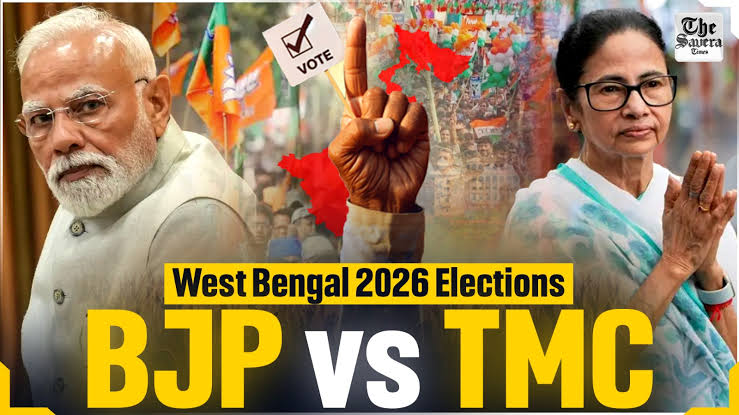
Why is it a Historical Necessity for BJP to Win West Bengal. By Rahul Saridena
Spokesperson, Bharatiya Janata Party, Telangana
As a proud spokesperson of the Bharatiya Janata Party in Telangana, I have witnessed firsthand the transformative power of Prime Minister Narendra Modi’s vision of Sabka Saath, Sabka Vikas, Sabka Vishwas. From the vibrant fields of Telangana to the bustling streets of Hyderabad, we have seen how the BJP’s double-engine governance model has unlocked potential, fostered development, and restored cultural pride. Yet, as we look east towards West Bengal, a state that once ignited the flames of Indian nationalism, I am convinced that a BJP victory in the upcoming assembly elections is not merely an electoral goal - it is a historical necessity. Bengal, the land that gave us Bankim Chandra Chatterjee’s Vande Mataram, the revolutionary spirit of the Swadeshi movement, and the intellectual bedrock of modern India, cannot remain trapped in the quagmire of misrule, violence, and appeasement. For the soul of India, for the unity of Bharat, and for the realization of a Viksit Bharat by 2047, BJP must win West Bengal.
This is not rhetoric born of partisan fervor alone. It is a call rooted in history, economics, security, and the aspirations of 10 crore Bengalis who deserve better than the syndicate raj, cut-money culture, and jungle raj that has defined the last 15 years under the Trinamool Congress (TMC). West Bengal is not just another state with 42 Lok Sabha seats. It is the cultural and historical heartland where Indian nationalism first found its voice. To reclaim Bengal is to reclaim the very idea of a strong, united, culturally rooted India that the BJP under Modi ji embodies.
Let us examine why this victory is imperative.
Bengal’s Glorious Past: The Cradle of Indian Nationalism
West Bengal’s place in Indian history is unparalleled. In the 19th century, Bengal was the epicenter of the Bengal Renaissance, a period of intellectual awakening that challenged colonial rule and social evils. Figures like Raja Ram Mohan Roy, Ishwar Chandra Vidyasagar, and Rabindranath Tagore reshaped modern India’s social and literary landscape. But beyond the progressive reforms, Bengal nurtured a powerful strand of Hindu nationalist thought. As noted by political scientists, Kolkata and undivided Bengal developed a distinct Hindu nationalist sentiment intertwined with anti-colonial fervor. Bankim Chandra Chatterjee’s Anandamath and the immortal Vande Mataram were not mere songs—they were battle cries that united Hindus across the subcontinent against British divide-and-rule tactics.
The 1905 Partition of Bengal, engineered by the British to weaken the nationalist movement, backfired spectacularly. It sparked the Swadeshi movement, boycotts, and revolutionary activities that inspired the entire nation. Leaders like Aurobindo Ghosh, Bipin Chandra Pal, and Lala Lajpat Rai drew strength from Bengal’s soil. Even Shyama Prasad Mookerjee, the founder of the Bharatiya Jana Sangh—the ideological precursor to the BJP—hailed from Bengal. His vision of integral humanism and opposition to partition was deeply rooted in Bengali ethos. Mookerjee’s sacrifice in 1953 while protesting the special status of Jammu and Kashmir remains a beacon for the BJP’s commitment to national unity.
Post-independence, however, Bengal’s trajectory diverged. The communist rule from 1977 to 2011 stifled industry, drove away capital, and turned the state into a laboratory for ideological experiments that prioritized class warfare over development. The TMC, which ousted the Left in 2011 promising change, merely replaced one form of stagnation with another—corruption-laced populism. The BJP’s rise in Bengal since 2014 is not an intrusion; it is a homecoming. It is the fulfillment of the Hindu nationalist strand that Asish Nandy described as inherent to Bengal’s 19th-century thought. Winning Bengal today means reconnecting the state with its true legacy: one of cultural pride, self-reliance, and fearless patriotism. Without this reclamation, India’s national narrative remains incomplete. A BJP government in Bengal would revive Sonar Bangla the golden Bengal envisioned by Tagore -not as a slogan, but as a lived reality under Sabka Saath.
The Twin Scourges: Left Legacy and TMC Misrule
To understand the urgency, one must confront the grim reality of Bengal under prolonged misgovernance. The Left Front’s 34-year rule decimated Bengal’s economy. Once the industrial engine of the East, contributing significantly to India’s GDP in the 1960s, the state slipped due to militant trade unionism, land acquisition failures (remember Singur and Nandigram), and flight of capital. By the time TMC assumed power in 2011, Bengal was already lagging. But what followed was worse: a decade and a half of institutionalized corruption, political violence, and minority appeasement that has eroded the state’s fabric.
Under Mamata Banerjee’s TMC, “cut-money” has become the unofficial currency of governance. Development projects are held hostage by party syndicates demanding bribes. Roads remain unfinished, industries refuse to invest, and unemployment pushes youth towards despair or migration. Official data paints a damning picture: in the 1960s, Bengal’s per capita income was 27.5% above the national average; today, it lags behind by over 16%. The state’s rank in economic contribution has plummeted from among the top three to around 6th or lower in recent estimates, with GSDP growth consistently trailing national averages. Agriculture, once a strength, suffers from lack of modernization, while manufacturing has stagnated at a mere fraction of potential.
Worse still is the culture of violence. West Bengal has earned the dubious distinction of topping charts in political killings, crimes against women, and lawlessness. Incidents like Sandeshkhali, where TMC goons allegedly unleashed terror on women and land grabbers operated with impunity, shocked the nation. NCRB data consistently shows Bengal leading in certain categories of atrocities against women, including a disproportionate share of acid attacks. Post-poll violence in panchayat and assembly elections has become routine, with opposition workers targeted systematically. The TMC’s response? Denial and deflection.
Demographic engineering compounds the crisis. With a 569-km porous border with Bangladesh, unchecked infiltration has altered the social landscape in border districts. Union Home Minister Amit Shah has rightly highlighted how states like West Bengal, Bihar, and Jharkhand are worst affected by illegal immigration. Fake documents, vote-bank politics, and soft-pedaling on radical elements have compromised national security and communal harmony. Bengal’s famed syncretic culture - Baul traditions, Durga Puja - is being overshadowed by a politics of selective appeasement that ignores the majority’s aspirations while failing the minorities it claims to protect.
Economically and socially, Bengal under TMC mirrors the failures of the old Left: ideology over progress, doles over jobs, fear over freedom. Youth unemployment is rampant, women feel unsafe, and farmers are trapped in debt without adequate irrigation or markets. Compare this to BJP-ruled states: Gujarat’s industrial prowess, Uttar Pradesh’s infrastructure boom under Yogi Adityanath, or even the strides in northeastern states. Telangana itself, despite challenges, has benefited from BJP’s national policies like PM-KISAN, Ayushman Bharat, and Ujjwala—schemes that TMC often undermines or claims credit for selectively.
Facts and Figures: 15 Years of TMC Failure
Let us speak with data, for numbers do not lie. West Bengal’s GSDP contribution to India’s economy has declined relative to peers. Once an industrial powerhouse with jute, tea, and engineering sectors thriving, the state now ranks low in ease of doing business. Private investment has fled; NRI Bengalis invest elsewhere. Poverty reduction claims by TMC are contradicted by ground realities—migration to other states for menial jobs continues unabated.
In 2023-24, crimes against women stood at alarming levels, with Bengal reporting thousands of cases annually, including dowry deaths and rapes often linked to political patronage. The state’s unemployment rate, particularly among educated youth, far exceeds national figures, fueling frustration evident in viral rap songs and street protests against “goonda raj.” Infiltration data from central agencies points to thousands of illegal entrants altering voter demographics, a threat Amit Shah has vowed to reverse under BJP rule.
Contrast this with the Modi era’s national achievements: over 50 crore Jan Dhan accounts, 14 crore toilets under Swachh Bharat, and digital infrastructure empowering the poor. In BJP states, double-digit growth in sectors like renewable energy, highways, and startups is the norm. Bengal’s tertiary sector dominance (services at ~54% of GSDP) masks the hollowing out of primary and secondary sectors. A BJP victory would unleash central schemes fully—without the “cut” leakage—reviving MSMEs, tourism (think Sundarbans, Darjeeling), and IT hubs in Kolkata.
The 2021 Assembly elections saw BJP surge to 77 seats and nearly 38% vote share from near-zero a decade ago. In 2024 Lok Sabha polls, despite TMC retaining 29 seats, BJP held steady at around 39% votes and 12 seats. This demonstrates a clear anti-incumbency wave. The people of Bengal are awakening; the historical necessity is aligning with popular will.
BJP’s Vision: Development, Security, and Cultural Revival
A BJP government in West Bengal would implement the proven “double engine” model. Imagine industrial corridors linking Kolkata to the Northeast, skill centers creating lakhs of jobs, and zero-tolerance policing ending syndicate terror. PM Modi’s guarantee of Viksit Bengal includes modernizing ports, boosting fisheries, and promoting “One District, One Product” for artisans. Cultural initiatives like a Vande Mataram Museum would honor Bengal’s heritage globally.
On security, sealing borders, NRC implementation where feasible, and deporting infiltrators would restore peace. Women’s safety through strict enforcement, as in UP, would end Sandeshkhali-like horrors. Economically, per capita income would rise above national averages within a term, mirroring Gujarat’s journey from similar challenges.
From Telangana’s perspective, as a southern state, I see the national imperative clearly. BJP’s success in the South—expanding in Karnataka, making inroads elsewhere—shows our party transcends regions. Bengal’s win would complete the saffron wave, weakening divisive opposition alliances like INDIA and ensuring Modi ji’s third term delivers uninterrupted progress.
Strategic Imperative for a Viksit Bharat
Electorally, 42 Lok Sabha seats are decisive. Ideologically, reclaiming Bengal counters the Left-TMC ecosystem that once exported Naxalism and now exports anarchy. Culturally, it revives Hindu pride without alienating anyone—Sabka Saath. Demographically and strategically, a secure Bengal fortifies India’s eastern frontier against external threats.
The Ganga flows from Bihar to Bengal; as Modi ji said after Bihar’s victory, the cleanup of “jungle raj” must reach Bengal. History demands it: from the 1905 anti-partition struggle to today’s battle against internal division.
The People’s Mandate: Time for Change
Bengal’s youth, women, and farmers have suffered enough. Rap songs decrying TMC scams, street protests against corruption, and panchayat results where BJP outperformed expectations signal the tide is turning. Internal TMC fissures, defections to BJP, and grassroots mobilization by RSS-BJP workers are unstoppable.
In 2026, Bengalis will choose Sonar Bangla over syndicate Bengal. The BJP is ready—with booth-level organization, welfare delivery, and a development roadmap tailored to Bengal’s strengths.
Conclusion: A Historical Imperative
Winning West Bengal is a historical necessity because it completes the unfinished journey of Indian nationalism. It redeems the land of Vande Mataram from the clutches of dynastic, corrupt, and divisive forces. It ensures economic justice, social harmony, and national security for every Indian. From Telangana to Tripura, the BJP stands united in this mission. Under Narendra Modi’s leadership, Bengal will rise again—not as a footnote in decline, but as a beacon of resurgence.
The time is now.
Jai Hind.
Vande Mataram.
Bharat Mata Ki Jai.
BJP win will and unite all the nationalists and infiltraters will be eliminated. JAI HIND.
And stop the infiltration.
BJP win will and unite all the nationalists and infiltraters will be eliminated. JAI HIND.
And stop the infiltration.
Congratulations Rahul being appointed as Spokesperson, BJP, Telangana