
High Voter Turnout in West Bengal Phase 1 - Boosting BJP’s Momentum Through Strategic Leadership.
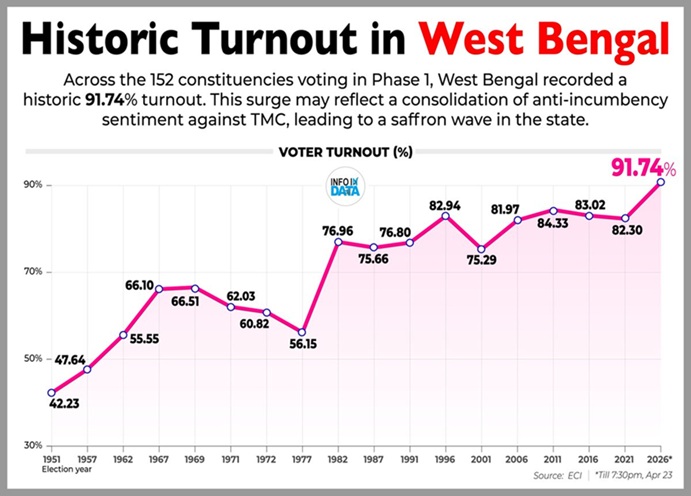
The first phase of the 2026 West Bengal Assembly elections recorded a notably high voter turnout across constituencies in North Bengal, Jangalmahal, and select South Bengal areas. This surge in participation highlights strong public engagement and sets a positive tone for the Bharatiya Janata Party (BJP) as subsequent phases unfold. Such elevated turnout often reflects deep anti-incumbency sentiments and effective ground mobilization, offering the BJP distinct advantages in its quest for expanded influence in the state.
Central to this emerging momentum are the pivotal roles played by Prime Minister Narendra Modi and Union Home Minister Amit Shah. Their leadership has been instrumental in shaping the party’s strategy, narrative, and organizational push in West Bengal.
1. Narendra Modi: The Face of Change and Mass Mobilizer
Prime Minister Narendra Modi has emerged as the primary architect of BJP’s appeal in Bengal, transforming the campaign into a broader call for “positive transformation.” Through extensive rallies and public addresses, Modi has consistently highlighted themes of development, cultural pride, good governance, and freedom from “politics of fear.” His direct outreach to diverse sections—including women, youth, and tribal communities—has energized voters who might otherwise have stayed away.
Modi’s emphasis on central welfare schemes reaching beneficiaries directly has built tangible credibility on the ground. In the context of high Phase 1 turnout, his interpretation of such numbers as a “silent wave for change” resonates strongly. By positioning the election as a battle between aspiration and stagnation, Modi has helped consolidate support in BJP-leaning regions and attract fence-sitters, giving the party a clear national-versus-regional narrative advantage.
2. Amit Shah: Master Strategist and Organizational Architect
Amit Shah, known for his meticulous election management, has focused on strengthening BJP’s booth-level machinery and long-term organizational expansion in the state. His hands-on involvement in cadre training, alliance coordination, and micro-level planning has ensured that the party’s message reaches even remote polling booths. Shah has particularly stressed electoral integrity, backing initiatives to refine voter lists and ensure a level playing field through robust security coordination.
This groundwork has directly contributed to the peaceful and high-turnout polling observed in Phase 1. Shah’s strategic vision—emphasizing data-driven targeting of key demographics and countering perceived irregularities—has helped convert organizational strength into actual voter participation. His behind-the-scenes role has been crucial in North Bengal and Jangalmahal areas, where BJP has seen sustained growth, turning potential strongholds into high-mobilization zones.
3. Combined Impact on Anti-Incumbency and Voter Consolidation
Together, Modi and Shah have amplified BJP’s core messages around security, infiltration control, infrastructure, and ending dynastic or appeasement-based politics. Their complementary styles—Modi’s inspirational mass connect and Shah’s precise execution—have created a powerful synergy. This has encouraged broader Hindu consolidation and aspirational voting in Phase 1 regions, while reducing the effectiveness of traditional bloc-voting tactics.
The high turnout benefits from this duo’s approach in several ways:
- Cleaner Electoral Process: Efforts supported under their guidance have motivated genuine voters, including migrants, to participate actively.
- Reduced Intimidation: Enhanced central focus on fair polling has allowed silent anti-incumbency voices to emerge without fear.
Sustained Campaign Energy: Their leadership provides a strong tailwind for remaining phases, converting Phase 1 enthusiasm into broader momentum.
4. Psychological and Long-Term Edge
The involvement of Modi and Shah lends BJP a perception of seriousness and deliverability that contrasts with regional incumbency fatigue after 15 years. This high-turnout phase validates their Bengal-focused strategy and positions the party favorably for potential gains, alliances, or even a majority push. While local issues and candidate strength remain key, the national leadership’s imprint helps frame the election as part of a larger story of political realignment in eastern India.
The Trinamool Congress may continue to rely on its welfare narrative and local networks, but the scale of participation in contested zones underscores the effectiveness of BJP’s top-driven momentum. As the election progresses, the roles of Narendra Modi and Amit Shah are likely to remain central—driving narratives, motivating workers, and converting high turnout into electoral dividends for the saffron party.
In summary, the record voter enthusiasm in West Bengal Phase 1 is not just a democratic milestone; it reflects a strategically nurtured shift. With Modi and Shah at the helm of BJP’s efforts, the party enters the next phases with strengthened prospects, organizational readiness, and a compelling vision that could significantly reshape the state’s political landscape.
The views expressed here are of
Dr Rahul Saridena
Spokesperson BJP Telangana
M # 9959988688
rahul.saridena@gmail.com

The first phase showed that many Hindu voters felt safe and confident enough to come out in large numbers. This has created a sense of momentum and courage for the next group of voters. Because of this energy, there is a strong belief that the BJP will secure a massive victory, potentially winning more than 155 seats.
After few decades not a single violent incident was reported in phase 1. Hope people participate in huge numbers and give clear mandate to WB future!