
Save Rajendranagar: A Survival Protest Against Administrative Isolation and Political Expansion
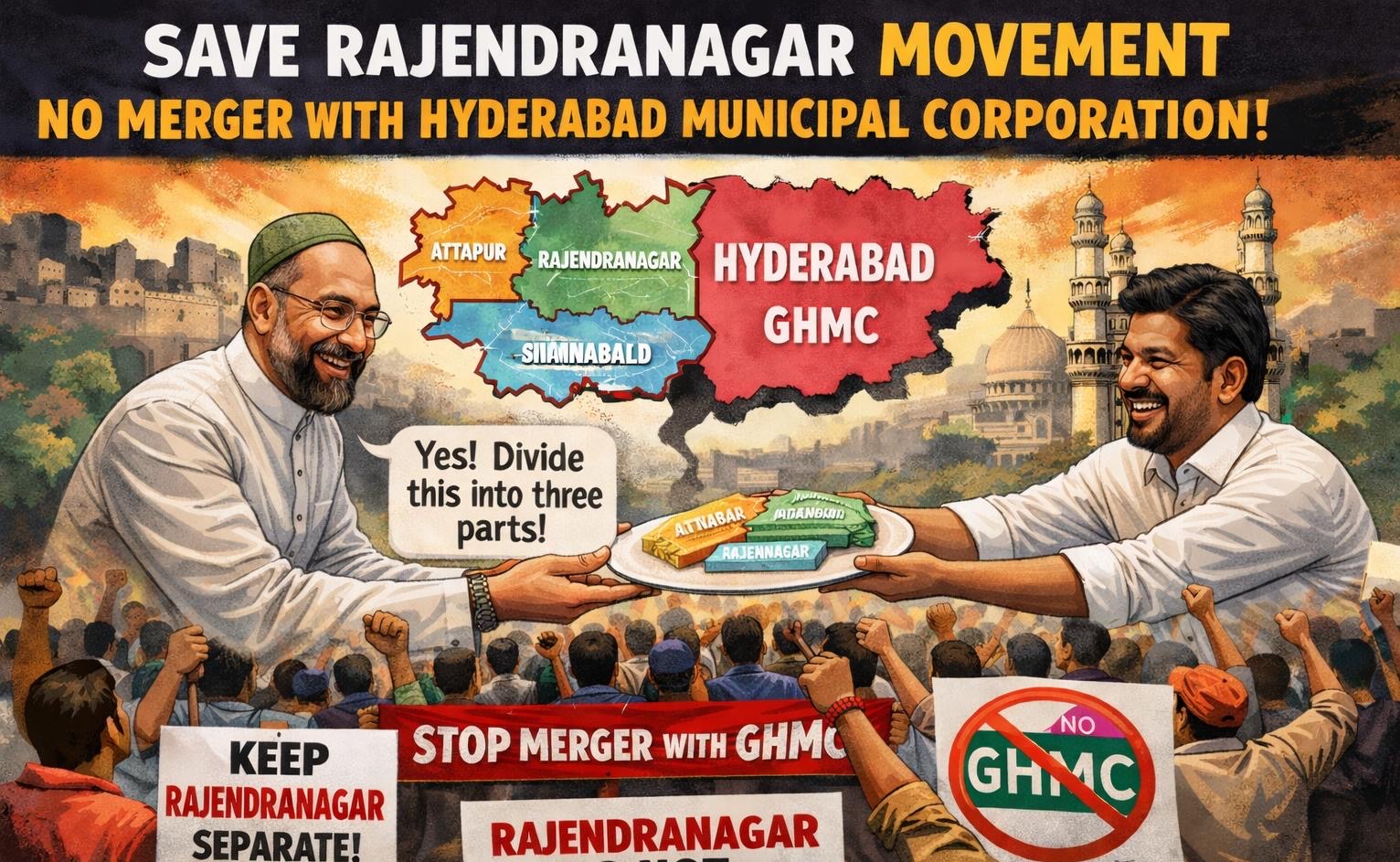
A Civilization-Crisis, Not a Routine Protest
Rajendranagar, a vital Assembly constituency on Hyderabad’s periphery near the Rajiv
Gandhi International Airport and the Outer Ring Road, stands today at a decisive moment in
its history.
The #SaveRajendranagar movement is not an ordinary political agitation. It is a survival protest, a desperate struggle for existence after decades of administrative neglect, systemic avoidance, and being treated as a political football between multiple commissionerates and municipal corporations. Residents are not demanding privilege. They are fighting for dignity, stability, and the basic right to feel secure in their own homes and neighbourhoods.
Decades of Administrative Isolation
For years, Rajendranagar has remained caught between overlapping authorities. Instead of coordinated governance, the constituency has experienced fragmentation. Development works are delayed, civic complaints remain unresolved, and accountability disappears between departments. Peripheral regions are often ignored in urban planning until electoral calculations or real estate interests emerge. This pattern has left Rajendranagar isolated within its own city, without timely development, reliable civic services, or a clear administrative identity.
The Demand: Governance That Matches Reality
The Save Rajendranagar campaign calls for logical administrative integration into the Cyberabad Municipal Corporation. Rajendranagar’s semi-urban character, growing population, and strategic location require focused governance rather than bureaucratic confusion. A single accountable civic authority can end the long-standing institutional tug-of-war and deliver development that reflects ground realities and local needs.
The Threat of Trifurcation
The proposed municipal restructuring presents what residents view as an existential threat. Dividing Rajendranagar into three different corporations risks weakening its collective voice and administrative unity. Within the existing Rajendranagar zone of 29 wards, projections suggest that MIM could secure 21 seats directly, with support in another four wards, while the remaining seats would be contested among other parties. In a larger GHMC structure of 150 wards, Rajendranagar’s representation could shrink to barely four seats. In a city administration serving nearly 75 lakh people, local issues risk being permanently sidelined.
Governance Breakdown and Everyday Consequences
Residents fear that merging into a larger structure without clarity will worsen governance challenges. Matters relating to law and order, sanitation, infrastructure maintenance, and civic administration may continue shifting between offices without ownership or responsibility. Peripheral areas often become dumping zones for unresolved problems. Even routine issues such as stray animal management or sanitation complaints risk remaining unattended simply because the area lies on administrative margins. This concern comes from lived experience, not political rhetoric.
Fear of Political Expansion Through Administrative Means
At the centre of the crisis lies a growing fear that administrative restructuring may indirectly enable political expansion rather than reflect democratic choice. Many residents believe the proposed changes could strengthen the influence of AIMIM leader Asaduddin Owaisi in Rajendranagar, something electoral politics has not achieved over the past two decades. Supporters of the movement see the current moment as a turning point. If such restructuring continues unchecked, they fear the pattern of influence could gradually extend toward Shamshabad and even Shadnagar.
Historical Memory and Collective Anxiety
The concerns expressed today are shaped by historical memory. Hyderabad’s political and demographic landscape has evolved significantly over decades. Areas once known for social balance have witnessed gradual transformations that many residents feel were ignored until it was too late. As a resident of Rajendranagar, this issue is deeply personal. People fear displacement, not through sudden events, but through slow administrative change. Many national conversations remember large historical migrations, yet smaller local displacements often remain undocumented and unheard. The Save Rajendranagar movement emerges from this collective anxiety, a determination not to remain silent when early warning signs are visible.
Broad Political Attention
Opposition to the proposed division has attracted attention from leaders across political lines. Union Minister Kishan Reddy has openly opposed the restructuring affecting Rajendranagar. The Bharatiya Janata Party (BJP) has officially supported the Save Rajendranagar campaign, with Telangana BJP State President Ramachander Rao reiterating the party’s stand against the proposed division. Member of Parliament Konda Vishweshwar Reddy has also raised strong objections, and the issue has been discussed in the Telangana Legislative Assembly by local MLA Prakash Goud himself. Such cross-party concern reflects the seriousness of the matter and the depth of public sentiment.
Core Demands of #SaveRajendranagar
- Formal merger of Rajendranagar into the Cyberabad Municipal Corporation to end administrative conflict.
- Protection of local identity from politically motivated boundary changes.
- Transparent, people-centric governance ensuring balanced and accountable development.
Rajendranagar’s Strategic Importance
Rajendranagar occupies a unique position within Hyderabad’s expanding geography. It connects the international airport, major infrastructure corridors, and growing residential communities while maintaining social balance and livability. Residents believe such regions should be strengthened through thoughtful planning and stable governance, not fragmented through administrative experimentation.
Conclusion
A Stand for Survival and Future Generations
The message of #SaveRajendranagar is clear and uncompromising. This is a fight for survival, identity, and civilizational continuity. Rajendranagar refuses administrative isolation. Rajendranagar refuses political expansion through boundary manipulation. Rajendranagar demands governance, dignity, and a secure future. The campaign calls upon citizens, policymakers, and elected representatives to recognise the stakes involved. Peaceful advocacy, democratic engagement, and public awareness have already begun to draw attention in legislative forums, but the struggle is far from over. The people of Rajendranagar have chosen to stand up peacefully, democratically, and firmly to protect their home for future generations.
Author: B. Ramprasad Goud
Initiator: #SaveRajendranagar
Comments
Your Comment